
Dodge Charger: BODYWORK / Protection From Atmospheric Agents
Vehicle body care requirements vary according to geographic locations and usage. Chemicals that make roads passable in snow and ice and those that are sprayed on trees and road surfaces during other seasons are highly corrosive to the metal in your vehicle. Outside parking, which exposes your vehicle to airborne contaminants, road surfaces on which the vehicle is operated, extreme hot or cold weather and other extreme conditions will have an adverse effect on paint, metal trim, and underbody protection.
The following maintenance recommendations will enable you to obtain maximum benefit from the corrosion resistance built into your vehicle.
What Causes Corrosion?
Corrosion is the result of deterioration or removal of paint and protective coatings from your vehicle.
The most common causes are:
- Road salt, dirt and moisture accumulation.
- Stone and gravel impact.
- Insects, tree sap and tar.
- Salt in the air near seacoast localities.
- Atmospheric fallout/industrial pollutants.
 BODYWORK
..
 Body And Underbody Maintenance
Cleaning Headlights
Your vehicle is equipped with plastic headlights and fog lights that are lighter
and less susceptible to stone breakage than glass headlights...
Other information:
Dodge Charger 2011-2026 Owner's Manual: To Activate/Deactivate
Push and release the Adaptive Cruise Control (ACC) on/off button. The ACC menu in the instrument cluster displays “ACC Ready.” To turn the system off, push and release the Adaptive Cruise Control (ACC) on/off button again. At this time, the system will turn off and the instrument cluster displays “Adaptive Cruise Control (ACC) Off...
Dodge Charger 2011-2026 Owner's Manual: Preparations For Jump Start
The battery is stored under an access cover in the trunk. Remote battery posts are located on the right side of the engine compartment for jump starting. Remote Positive (+) Post Remote Negative (-) Post NOTE: The remote battery posts are viewed by standing on the right side of the vehicle looking over the fender...
Categories
- Manuals Home
- Dodge Charger Owners Manual
- Dodge Charger Service Manual
- To Lock/Unlock The Doors And Trunk
- Keyless Enter-N-Go — Passive Entry
- Blind Spot Monitoring (BSM) — If Equipped
- New on site
- Most important about car
Power Door Locks
The power door lock switches are located on each front door panel. Push the switch to lock or unlock the doors.
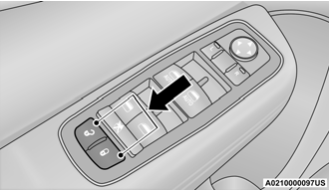
The driver’s door will unlock automatically if the keys are found inside the vehicle when the door lock button on the front door panel is used to lock the door. This will occur for two attempts. Upon the third attempt, the doors will lock even if the key is inside.
