Dodge Charger: AUXILIARY DRIVING SYSTEMS / Blind Spot Modes
Blind Spot Alert Lights Only
Blind Spot has three selectable modes of operation that are available in the Uconnect system.
When operating in Blind Spot Alert mode, the BSM system will provide a visual alert in the appropriate side view mirror based on a detected object. However, when the system is operating in Rear Cross Path mode, the system will respond with both visual and audible alerts when a detected object is present. Whenever an audible alert is requested, the radio volume is reduced so that the alert can be better heard.
https://ecufix.infoBlind Spot Alert Lights/Chime
When operating in Blind Spot Alert Lights/ Chime mode, the BSM system will provide a visual alert in the appropriate side view mirror based on a detected object. If the turn signal is then activated, and it corresponds to an alert present on that side of the vehicle, an audible chime will also be sounded. Whenever a turn signal and detected object are present on the same side at the same time, both the visual and audio alerts will be issued. In addition to the audible alert the radio (if on) volume will be reduced so that the alert can be better heard.
When the system is in RCP, the system shall respond with both visual and audible alerts when a detected object is present. Whenever an audible alert is requested, the radio volume is reduced so that the alert can be better heard.
Blind Spot Alert Off
When the BSM system is turned off there will be no visual or audible alerts from either the BSM or RCP systems.
NOTE:
The BSM system will store the current operating mode when the vehicle is shut off. Each time the vehicle is started the previously stored mode will be recalled and used.
 Rear Cross Path (RCP)
RCP is intended to aid the driver when backing out of parking spaces where their
vision of oncoming vehicles may be blocked. Proceed slowly and cautiously out of
the parking space until the rear end of the vehicle is exposed...
 Forward Collision Warning (FCW) With Mitigation Operation
FCW with Mitigation provides the driver with audible warnings, visual warnings
(within the instrument cluster display), and may apply haptic warning in the form
of a a brake jerk, to warn the driver when it detects a potential frontal collision...
Other information:
Dodge Charger 2011-2026 Owner's Manual: Android Auto™
Use this QR code to access your digital experience. Android Auto™ is a feature of your Uconnect system, and your Android™ 5.0 or higher powered smartphone with a data plan, that allows you to project your smartphone and a number of its apps onto the touchscreen radio display...
Dodge Charger 2011-2026 Owner's Manual: Anti-Lock Brake System (ABS)
The ABS provides increased vehicle stability and brake performance under most braking conditions. The system automatically prevents wheel lock, and enhances vehicle control during braking. The ABS performs a self-check cycle to ensure that the ABS is working properly each time the vehicle is started and driven...
Categories
- Manuals Home
- Dodge Charger Owners Manual
- Dodge Charger Service Manual
- Keyless Enter-N-Go — Passive Entry
- Jump Starting Procedure
- High/Low Beam Switch, Automatic High Beam — If Equipped
- New on site
- Most important about car
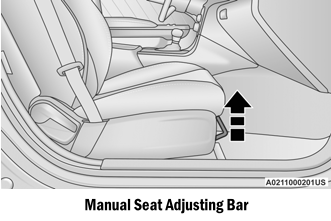
Manual Front Seat Forward/Rearward Adjustment
Some models may be equipped with a manual front passenger seat. The seat can be adjusted forward or rearward by using a bar located by the front of the seat cushion, near the floor.