Dodge Charger: WINDSHIELD WIPERS AND WASHERS / Rain Sensing Wipers — If Equipped
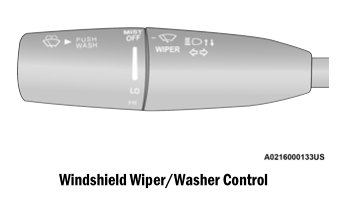
This feature senses rain or snowfall on the windshield and automatically activates the wipers. Rotate the end of the multifunction lever to one of four detent positions to activate this feature.
The sensitivity of the system can be adjusted with the multifunction lever. Wiper delay position one is the least sensitive, and wiper delay detent position four is the most sensitive.
Wiper delay position three should be used for normal rain conditions.
NOTE:
- The Rain Sensing feature will not operate when the wiper switch is in the low or high-speed position.
- The Rain Sensing feature may not function properly when ice, or dried salt water is present on the windshield.
- Use of Rain-X or products containing wax or silicone may reduce Rain Sensing perfor- mance.
- The Rain Sensing feature can be turned on and off using the Uconnect system.
The Rain Sensing system has protection features for the wiper blades and arms, and will not operate under the following conditions:
- Low Ambient Temperature — When the igni- tion is first placed in the ON position, the Rain Sensing system will not operate until the wiper switch is moved, vehicle speed is greater than 3 mph (5 km/h), or the outside temperature is greater than 32°F (0°C).
- Transmission In NEUTRAL Position — When the ignition is ON, and the automatic trans- mission is in the NEUTRAL position, the Rain Sensing system will not operate until the wiper switch is moved, vehicle speed is greater than 3 mph (5 km/h), or the gear selector is moved out of the NEUTRAL posi- tion.
- Remote Start Mode Inhibit — On vehicles equipped with Remote Start system, Rain Sensing wipers are not operational when the vehicle is in the Remote Start mode.
 Windshield Wiper Operation
Rotate the end of the multifunction lever to the first detent, past the intermittent
settings for low-speed wiper operation, or to the second detent past the intermittent
settings for high-speed wiper operation...
 CLIMATE CONTROLS
The Climate Control system allows you to regulate the temperature, air flow,
and direction of air circulating throughout the vehicle. The controls are located
on the touchscreen (if equipped) and on the instrument panel below the radio...
Other information:
Dodge Charger 2011-2026 Owner's Manual: Jack Location/Spare Tire Stowage
The jack and spare tire are both stowed under an access cover in the trunk. Follow these steps to access the jack and spare tire. NOTE: The spare tire must be removed in order to access the jack. Open the trunk. Lift the access cover using the pull strap...
Dodge Charger 2011-2026 Owner's Manual: Performance Control — If Equipped
Your vehicle may be equipped with a Performance Control feature which allows for coordinating the operation of various vehicle systems depending upon the type of driving behavior desired. The Performance Control feature is controlled through the Uconnect system and may be accessed by performing any of the following: Pushing the Super Track Pack button on the instrument panel switch bank...
Categories
- Manuals Home
- Dodge Charger Owners Manual
- Dodge Charger Service Manual
- Opening And Closing The Trunk
- SCHEDULED SERVICING
- High/Low Beam Switch, Automatic High Beam — If Equipped
- New on site
- Most important about car
WINDSHIELD WIPERS AND WASHERS
The windshield wiper/washer controls are located on the multifunction lever on the left side of the steering column. The front wipers are operated by rotating a switch, located on the end of the lever.