
Dodge Charger: Tires — General Information / Tire Spinning
When stuck in mud, sand, snow, or ice conditions, do not spin your vehicle's wheels above 30 mph (48 km/h) or for longer than 30 seconds continuously without stopping.
WARNING!
Fast spinning tires can be dangerous. Forces generated by excessive wheel speeds may cause tire damage or failure. A tire could explode and injure someone. Do not spin your vehicle's wheels faster than 30 mph (48 km/h) for more than 30 seconds continuously when you are stuck, and do not let anyone near a spinning wheel, no matter what the speed.
 Run Flat Tires — If Equipped
Run Flat tires allow you the capability to drive 50 miles (80 km) at 50 mph (80
km/h) after a rapid loss of inflation pressure. This rapid loss of inflation is
referred to as the Run Flat mode...
 Tread Wear Indicators
Tread wear indicators are in the original equipment tires to help you in determining
when your tires should be replaced.
Worn Tire
New Tire
These indicators are molded into the bottom of the tread grooves...
Other information:
Dodge Charger 2011-2026 Owner's Manual: Manual Front Seat Recline
To adjust the seatback, lift the lever located on the outboard side of the seat, lean back to the desired position and release the lever. To return the seatback, lift the lever, lean forward and release the lever. WARNING! Do not ride with the seatback reclined so that the shoulder belt is no longer resting against your chest...
Dodge Charger 2011-2026 Owner's Manual: To Turn Off, To Resume
To Turn Off The system will turn off and erase the set speed in memory if: The Adaptive Cruise Control (ACC) on/off button is pushed The Fixed Speed Cruise Control on/off button is pushed The ignition is placed in the OFF position To Resume If there is a set speed in memory, push the RES (resume) button and remove your foot from the accelerator pedal...
Categories
- Manuals Home
- Dodge Charger Owners Manual
- Dodge Charger Service Manual
- Dimmer Controls
- Launch Control
- WHEEL AND TIRE TORQUE SPECIFICATIONS
- New on site
- Most important about car
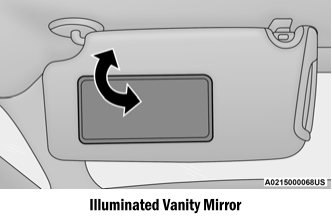
Illuminated Vanity Mirrors
To access an illuminated vanity mirror, flip down one of the visors and lift the cover.
Sun Visor “Slide-On-Rod” Feature — If Equipped
The sun visor “Slide-On-Rod” feature allows for additional flexibility in positioning the sun visor to block out the sun.
Fold down the sun visor. Unclip the visor from the corner clip. Pivot the sun visor toward the side window. Extend the sun visor for additional sun blockage.